
If you’re reading this before buying a sulcata tortoise, congratulations—you’re one of the few people doing research before making a 70-plus-year commitment to an animal that will outgrow every enclosure you own for the next decade. If you’re reading this because your “cute little hatchling” is already destroying your living room and you’re panicking about what comes next, well, you’re not alone.
Here’s the brutal truth about sulcata tortoise size that most pet stores won’t tell you: that adorable 2-inch baby will grow into a 100-150 pound giant that needs a backyard-sized outdoor enclosure, eats more vegetation than a lawnmower can keep up with, and will live longer than your mortgage. This isn’t a tortoise you can keep in a glass tank on your bookshelf. We’re talking about an animal that reaches the size of a medium dog and has the strength to literally push through fences.
What’s more, you will want to feed them enough so they grow quickly, but not too much that they grow too fast. That’s why we created our Baby Sulcata Superfood Powder to address the unique nutritional needs of baby sulcatas. New owners need to understand not just how big sulcatas get, but when they get that big, what that size means for daily care, and how to manage growth rates to prevent serious health problems.
This guide will give you the complete picture of sulcata size from hatchling to massive adult, including the housing transitions you’ll need to plan for, the growth rates that indicate healthy versus problematic development, and the reality of what living with a giant tortoise actually means.
- From Ping-Pong Ball to Giant: The Size Timeline
- Adult Size: The Numbers That Actually Matter
- The Growth Rate Problem Nobody Talks About
- Size-Based Housing: The Timeline Nobody Prepares For
- What Heavy Actually Means for Daily Care
- Alternative Species for Size-Conscious Keepers
- Supporting Healthy Size Development
- Ready to Make an Informed Decision?
From Ping-Pong Ball to Giant: The Size Timeline
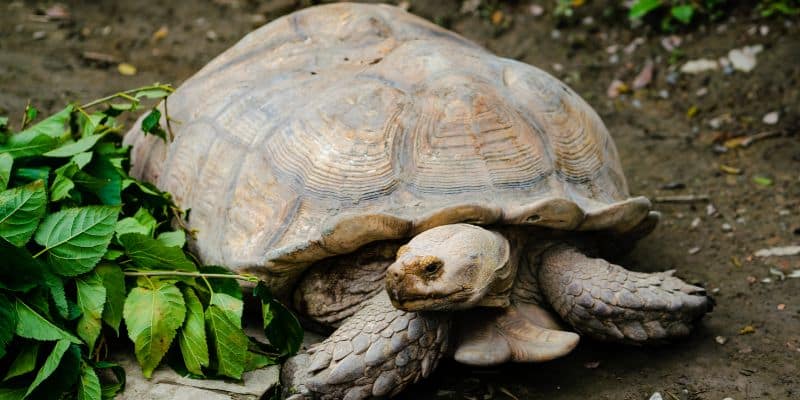
Sulcata hatchlings start life small enough to fit in the palm of your hand—just 1.5 to 2.5 inches across and weighing 20-40 grams. This tiny size is deceptive and leads many people to underestimate what they’re getting into. That cute little hatchling barely takes up any space in its enclosure, eats a few leaves, and seems perfectly manageable. Then the first year happens.
During their first year, healthy sulcatas can grow 2-4 inches in shell length. That’s potentially doubling or even tripling in size in just 12 months. By their first birthday, many sulcatas reach 200-400 grams in weight. Your carefully set-up hatchling enclosure will be obsolete before you’ve even mastered the daily care routine.
The juvenile growth period from 1-5 years is when things get really serious. Sulcatas can gain 1-3 inches per year during this period, reaching 8-15 inches by age 5. Weight increases dramatically from under a pound as a hatchling to 10-30 pounds as a 5-year-old. This is when most keepers realize they can’t provide adequate housing anymore and start frantically researching outdoor enclosure options.
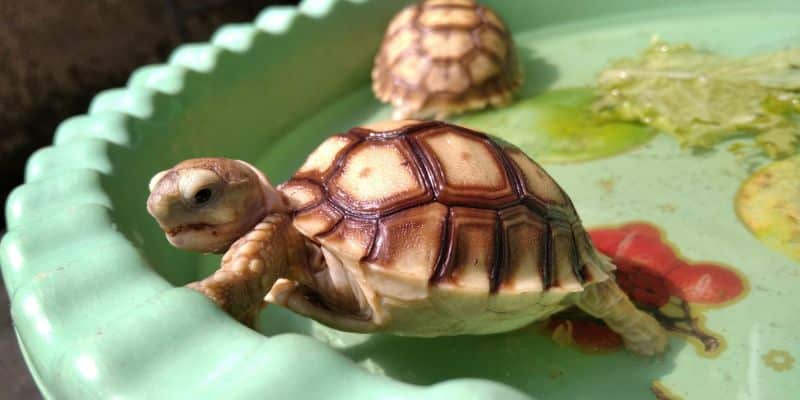
Growth continues at a slower pace from 5-10 years, typically adding 0.5-2 inches per year. By age 10, most sulcatas reach 15-20 inches and weigh 40-70 pounds. Males are noticeably larger than females by this point, and the size difference continues increasing throughout their lives.
Most sulcatas approach their adult size around 15-20 years old, though they continue growing slowly throughout their entire lives. The growth rate slows to barely perceptible changes year to year, but they never truly stop getting bigger.
Adult Size: The Numbers That Actually Matter
The average adult male sulcata measures 20-30 inches long and weighs 80-150 pounds. Some exceptional males exceed 200 pounds and reach shell lengths over 30 inches. These aren’t rare outliers—large sulcatas are fairly common when given proper care and adequate space.
Female sulcatas are generally smaller, measuring 18-24 inches long and weighing 60-100 pounds. They’re typically 20-30% smaller than males, though the exact difference varies by individual genetics and care quality.
The range in adult sulcata size is enormous, and understanding why this variation exists is important. Two tortoises receiving similar care can end up 50+ pounds different in weight. This comes down to genetic lineage—some bloodlines simply produce larger animals. Early nutrition during the first 2-3 years sets lifelong size patterns that can’t be changed later. Environmental conditions like temperature and humidity affect how efficiently tortoises grow. And individual metabolism means some tortoises are naturally larger-framed regardless of care.
The Growth Rate Problem Nobody Talks About
Here’s what catches many new sulcata owners by surprise: rapid growth isn’t a sign of good health. Many keepers accidentally cause rapid growth by overfeeding or providing inappropriate high-protein, high-calorie diets. They see their tortoise growing quickly and think they’re doing a great job, when actually they’re creating serious long-term problems.
Sulcatas that grow too quickly develop pyramiding, where the scutes grow upward in pyramid shapes instead of remaining flat. They develop soft shell areas that should be firm and hard. Their kidneys struggle with excess protein, leading to chronic kidney problems that shorten lifespan. They experience joint issues from rapid weight gain that their developing skeleton can’t support properly. And they often have reduced lifespans compared to slow-growing individuals—sometimes living 30-40 years instead of the potential 70+.
A sulcata that reaches 12 inches by age 2 is growing too fast and heading for health problems. Healthy growth is steady and slow—think marathon, not sprint. You want consistent monthly growth without dramatic spurts, smooth and flat shell development without pyramiding, firm shell that sounds solid when tapped gently, and proportional body weight to shell size.
Using properly formulated nutrition like our Baby Sulcata Superfood Powder helps maintain steady, healthy growth rates by providing optimal nutrient ratios without the overfeeding risks that come from free-feeding inappropriate foods. The goal isn’t to maximize size or growth speed—it’s to support sustainable development that builds a strong foundation for adult health.
When growth is too slow, that’s concerning for different reasons. If your sulcata isn’t showing measurable growth over 2-3 month periods, something’s wrong. Temperatures might be too low for proper metabolism. Inadequate UVB lighting prevents calcium absorption. Poor nutrition lacks essential nutrients. Underlying health problems like parasites are stealing resources. Or chronic stress from inappropriate housing is suppressing normal development.
Size-Based Housing: The Timeline Nobody Prepares For
Understanding size isn’t academic—it directly determines your housing needs at every stage, and these transitions happen faster than most people expect.
For hatchlings from 0-6 months old measuring 2-4 inches, you need a minimum of 8 square feet. That’s roughly a 2×4 foot enclosure. But here’s the reality check: you’ll need to upgrade in just months, so many keepers start with the next size up immediately to avoid immediate replacement costs.
Young juveniles from 6-12 months old measuring 4-7 inches need a minimum 18 square feet—around a 3×6 foot space. This is when indoor housing becomes challenging. The tortoise is too big for typical reptile enclosures but not quite ready for outdoor living in many climates. You’re in this awkward in-between stage that frustrates many keepers.
Older juveniles from 1-3 years old measuring 7-12 inches require a minimum 32 square feet, about a 4×8 foot enclosure. Indoor housing is extremely difficult at this stage unless you have an entire room to dedicate. Most keepers transition to outdoor enclosures or dedicated indoor rooms by this point.
Sub-adults from 3-7 years old measuring 12-18 inches need a minimum 96 square feet—that’s an 8×12 foot space. Full outdoor housing is essentially mandatory unless you have serious indoor space to dedicate. We’re talking about a significant commitment at this point.
Adult housing for tortoises 7+ years old measuring 18-30 inches requires a minimum 100-250 square feet. Many experts recommend 300+ square feet for optimal welfare. We’re talking about a significant portion of your yard dedicated permanently to tortoise housing.
Here’s the reality nobody mentions: these are minimums. Sulcatas are natural wanderers that can travel several miles daily in the wild. Larger is always better, and cramped conditions lead to stressed, frustrated tortoises that constantly try to escape and show behavioral problems.
What Heavy Actually Means for Daily Care
Size isn’t just about length—weight matters tremendously for practical care considerations that impact your daily life.
When your sulcata weighs 5-10 pounds, most people can easily lift and move them with one hand. It’s manageable and doesn’t require special planning. At 20-40 pounds, you need two hands and it’s getting awkward, especially when the tortoise is struggling or trying to move. By 50-70 pounds, it’s difficult for one person to handle safely, and getting them into a carrier for vet visits becomes a real challenge. At 100+ pounds, you absolutely need two people or special equipment for any transport. This isn’t like moving a dog—tortoises don’t cooperate and their weight is distributed awkwardly.
A 100-pound tortoise walking repeatedly over your floors can crack tiles with their weight concentrated on small feet. They can damage hardwood flooring over time. They knock over furniture and decorations without even trying. They push through inadequate barriers like they’re made of paper. And they destroy landscaping in outdoor enclosures just by moving around normally.
Finding a vet who can handle a 150-pound tortoise is harder than you think. Many exotic vets have weight limits on what they can safely examine and treat. Transport alone becomes a significant logistical challenge requiring sturdy containers that can hold the weight, a vehicle that can accommodate large carriers, and multiple people to help load and unload.
The Space-Time-Money Equation
Let’s talk about the financial reality that most guides skip over. You’re not buying one enclosure—you’re buying 3-5 progressively larger setups over 10-15 years. A hatchling setup costs $200-500. A juvenile setup runs $500-1,500. An adult outdoor enclosure can easily cost $2,000-10,000+ depending on size and features.
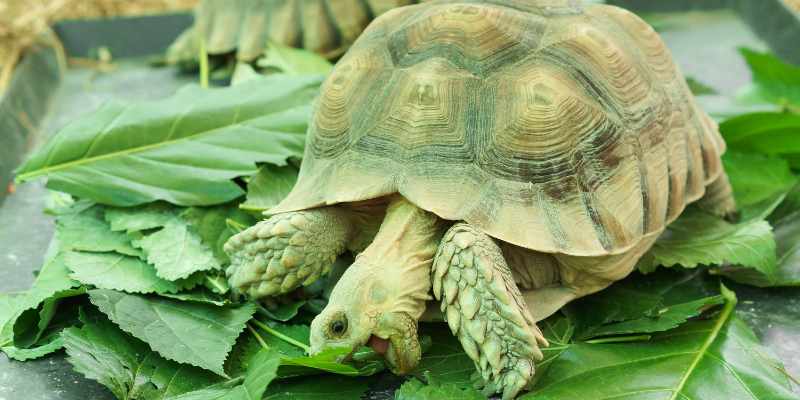
A sulcata that reaches full size at 15-20 years is only about one-third through its lifespan. You’re potentially looking at 50-70 more years with a fully-grown giant tortoise. Think about where you’ll be in 50 years. Will you still have this house with adequate outdoor space? Will you still be physically capable of caring for a 100+ pound animal?
Tortoises that experience rapid growth or develop size-related health problems often have reduced lifespans. A sulcata that reaches 80 pounds by age 5 from overfeeding might only live 30-40 years instead of the potential 70+. The growth choices you make in the first few years literally determine how long your tortoise lives.
Planning for the future means considering scenarios nobody wants to think about. What happens to your 100-pound tortoise if you move to a smaller home without yard space? What if you develop health problems that prevent lifting heavy animals? What if you experience financial difficulties? What happens to your tortoise if you pass away before it does? These aren’t pleasant scenarios, but they’re real possibilities over a 70-year timespan. Sulcata rescues are full of large tortoises whose owners couldn’t handle the size anymore.
Are You Starving Your Tortoise?
Save 10% on premium tortoise food and supplements from Tortoise Resource Center on Amazon now using code BUYNOWGET10
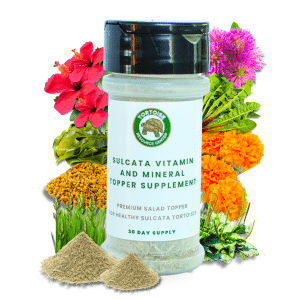
Sulcata Vitamin & Mineral Topper Supplement
30-Day Supply | 2 oz (56 g)
$24.99
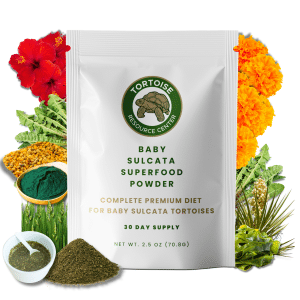
Baby Sulcata Tortoise Superfood Powder
30-Day Supply | 2.5 oz (70.8 g) Bag
$24.99
Preventing Size-Related Health Problems
Rapid growth causes metabolic bone disease even with calcium supplementation because the growth outpaces the body’s ability to properly mineralize bone and shell. Fast-growing sulcatas develop pyramiding and shell deformities that can’t be reversed. They experience joint problems from rapid weight gain.
Supporting healthy bone development requires more than just calcium—comprehensive mineral balance is essential. Our Vitamin and Mineral Topper provides the full spectrum of minerals needed for proper skeletal development during critical growth periods, helping ensure that growth happens at the right pace with proper bone and shell formation.
Yes, sulcatas can become obese despite their size. Overweight tortoises show visible fat deposits around neck and legs, difficulty retracting limbs into shell, reduced activity and mobility, and increased risk of organ problems. Obesity prevention requires appropriate diet composition—lots of low-calorie grasses and minimal high-calorie vegetables and fruits.
Making the Size Decision: Are You Really Ready?
Before committing to a sulcata, honestly assess your situation. Do you have 200+ square feet of outdoor space you can permanently dedicate to a tortoise? Can you maintain fencing that withstands a 100-pound animal with escape artist tendencies? Is your climate appropriate for year-round outdoor housing or do you need expensive heated shelter options?
Can you handle the physical demands for 50+ years? Can you lift 50+ pounds repeatedly for vet visits and enclosure maintenance? Can you modify your property for large tortoise housing with barriers, shelters, and appropriate landscaping?
Can you afford $2,000+ annually in food, housing maintenance, and veterinary care? Can you handle emergency veterinary costs for a giant tortoise, which are often more expensive than dog or cat emergencies? Can you fund multiple enclosure upgrades as your tortoise grows?
Can you dedicate 1-2 hours daily to tortoise care for decades? Can you arrange care during vacations—finding someone who can handle a large tortoise isn’t easy? Can you commit for potentially 70+ years, or at minimum have a solid plan for what happens to your tortoise when you can’t care for it anymore?
Does your municipality allow large tortoises? Some areas have restrictions on exotic pets or animals over certain sizes. Do HOA rules permit extensive tortoise enclosures? Some neighborhoods prohibit large outdoor structures. Can you legally keep sulcatas in your state? Some states have restrictions or require permits.
Alternative Species for Size-Conscious Keepers
If sulcata size is giving you second thoughts, you’re not alone. Many people love the idea of tortoise ownership but aren’t prepared for a 100+ pound animal. Consider these alternatives.
Russian tortoises reach adult sizes of 8-10 inches and 3-5 pounds. They need minimum 32 square feet of housing, which is manageable for most people. They have similar care requirements to sulcatas but in a much more manageable package.
Greek tortoises stay 6-8 inches and 2-4 pounds as adults. They need minimum 18 square feet of housing. They’re Mediterranean species that hibernate, which is different from sulcatas but manageable with proper guidance.
Hermann’s tortoises also reach 6-8 inches and 2-4 pounds. They need minimum 18 square feet of space. They’re popular European species well-suited to captivity with decades of breeding success making them readily available.
These species offer the tortoise-keeping experience without the massive size commitment. You still get a long-lived, personable reptile with fascinating behaviors, but in a size that fits into normal housing situations.
Supporting Healthy Size Development
If you’re committed to sulcata ownership despite understanding the size challenges, focus on supporting healthy development. Feed primarily grasses and appropriate weeds—this should be 75-80% of the diet. Limit high-calorie vegetables to small portions and eliminate fruit except as rare treats. Provide proper supplementation for bone development without overdoing it. Maintain optimal environmental conditions including temperature, humidity, and UVB lighting. Monitor growth rates monthly and adjust feeding if growth is too rapid.
Plan ahead for enclosure upgrades before they become urgent. Budget for progressive housing improvements so you’re never scrambling to provide adequate space. Establish a relationship with a large-animal exotic vet early, before you have an emergency with a tortoise too big for most vets to handle. Create contingency plans for potential life changes that might affect your ability to provide care.
Ready to Make an Informed Decision?
Understanding sulcata tortoise size isn’t just about knowing they “get big”—it’s about comprehending the practical, financial, and lifestyle implications of living with an animal that grows from hand-sized to the weight of a large person over just a few years.
The size trajectory of sulcatas is dramatic and irreversible. Once you commit to a hatchling, you’re committing to eventually housing a 100+ pound animal for potentially 70+ years. There’s no downsizing option, no return policy when they get too big, and no easy solutions if you underestimated the space and resources required.
But for those who truly can provide for a giant tortoise, sulcatas are remarkable animals—intelligent, personable, and absolutely captivating to live with. The key is making sure you understand exactly what you’re getting into before that cute hatchling grows into a magnificent giant that requires serious resources and commitment.
Want to ensure you’re fully prepared for sulcata ownership at every size stage? Download your free care bonus pack with detailed growth tracking charts, size-appropriate housing plans, feeding schedules by age, and a comprehensive readiness assessment to help determine if a sulcata is right for your situation.
Your decision about sulcata ownership will affect the next 70+ years of your life and the lifetime of an incredible animal. Make it an informed one.
Citations
- San Diego Zoo African Spurred Tortoise
- MedVet Sulcata Tortoise Background and Care Recommendations
- California Turtle & Tortoise Club Captive Tortoise Diet